
What Is GEO SEO? The Complete Guide to Generative Engine Optimization for Marketers

A last-minute product launch Q&A turns into a defining moment for one startup. Their blog post, short and factual, is the single source an LLM pulls into an answer that appears on page one of Google and in chat replies on Bing. Traffic spikes. Leads call. The marketing director smiles, because the team did not chase ranking alone. They optimized for being the answer.
This article explains GEO SEO, also called Generative Engine Optimization, and why marketers must design content so generative engines cite and surface their work. You will learn what GEO SEO means, how generative engines find and use content, the signals these engines prefer, and a practical, step-by-step playbook that scales. By the end you will have a repeatable process to create content that is machine-discoverable, people-first, and built to be cited.
Who benefits from GEO SEO? How do you prove generative engines are using your content? What is the first small change that delivers real results this week?
Table of contents
From a snippet to being cited
Why GEO SEO matters now
How generative engines find and use content
Signals that make content citable
On-page and technical tactics you can implement today
A step-by-step GEO process for marketing teams
Automation, governance, and human review
Measurement and KPIs for GEO
30/45/90 day implementation roadmap
Short, medium, and longer term implications
Action checklist
Key takeaways
FAQ
From a snippet to being cited
Generative Engine Optimization, or GEO SEO, is the practice of designing content, data, and technical signals so that large language models and generative search products cite, reference, and surface your content as authoritative answers. The goal shifts from chasing organic rank to becoming the source that answer engines quote. This matters because when an LLM uses your content in a result, you earn exposure, trust, and sometimes direct referral traffic. Upfront-AI customers report measurable lifts, including a 3.65x exposure increase within 45 days in similar campaigns. Small changes deliver clear business outcomes.
Why GEO SEO matters now
Search is moving fast. Google AI Overviews now appear in at least 16 percent of searches, and that share is growing rapidly, reshaping how buyers discover and evaluate products before ever clicking a link. Generative overlays such as Google Search Generative Experience and Bing Chat change how users expect answers. They expect concise responses, with sources, and they click less for long navigation.
That is an opportunity. If your content is not structured to be read by machines, you miss citations and visibility.
At the same time, human readers still prefer clarity and trust. GEO SEO is not a hack, it is a discipline. It asks one clear question, then answers it so both people and machines can use the content. This dual audience approach gives you the best of both channels.
How generative engines find and use content
Generative engines work in stages, and each stage gives you a place to win.
Retrieval
The engine selects candidate passages from its index. Content that is HTML text, accessible, and clearly labeled is easier to retrieve.
Ranking and scoring
Candidates are scored on authority, recency, relevance, and provenance. Engines favor clear citations and sources.
Generation
An LLM synthesizes an answer from the top sources. If your page provides concise, correctly sourced snippets, the engine can quote and cite you.
If you want a practical primer on shaping content to be cited, see the overview at llmrefs.com/generative-engine-optimization and a complementary walkthrough at trantorinc.com. These guides explain how retrieval and provenance change the calculus for content creators.
Signals that make content citable
These are the specific signals generative systems use. Strengthen each to improve your chances of being cited.
EEAT and authorship
Experience, expertise, authoritativeness, and trustworthiness matter. Show author bios, credentials, and organisational authority. A named author with a clear profile reduces friction for generative engines.
Freshness
Time-sensitive answers require up-to-date sources. Update core pages and display last-modified dates.
Structured data and schema
FAQ, Article, Person, Organization, Dataset, and QAPage schema all increase machine-readability. Use schema that mirrors visible content.
Answerable structure
Open with a short answer or summary. Use headings that match common questions. Add bullet lists and nested FAQs that break complex topics into atomic answers.
Provenance and citations
Link to primary sources, studies, and government or vendor docs when available. That explicit linking helps engines verify claims.
Semantic entities
Use consistent names for products, people, and concepts. Link across your content hub to build entity signals.
Page experience and accessibility
Fast pages, accessible HTML, and clear image alt text matter. Retrieval works better when content is easy to read and parse.
On-page and technical tactics you can implement today
These tactics are practical. Each one is short, testable, and aligned to GEO SEO.
Title and headings
Use descriptive H1 and H2 tags. Put the answer intent early. Example: H1: What Is GEO SEO? H2: How Generative Engines Use Content.
Short answer summaries
Add a 1–3 sentence summary at the top of long pages, framed as a crisp answer to a common question.
Add FAQ schema
Convert Q&A blocks into FAQ markup. This is low friction and high impact.
Author and organisation markup
Add Person schema for your author and Organisation schema for your company. Include sameAs links to social profiles when possible.
Citations and inline links
Cite studies and primary sources. Include URL-based evidence for claims. Keep the visible content consistent with any structured data you add.
Fast, accessible HTML
Place crucial content in HTML rather than hiding it behind heavy JavaScript. Validate that retrieval systems can crawl and read the content.
Canonicalisation and URL structure
Avoid duplicate answers across many pages. Use canonical tags and logical URLs - for example, /guides/geo-seo-generative-engine-optimization.
Data transparency
Publish data tables, charts, and source notes. Machines prefer explicit numbers and provenance.
A step-by-step GEO process for marketing teams
This process gives you a replicable workflow from idea to citation. You will produce content that generative engines can find, verify, and cite. You will set up metrics to measure LLM citations and answer impressions. You will build an editorial loop that uses AI for scale and humans for accuracy.
Step 1: research and outline
Identify the high-value question you want to own. Use analytics to find queries where users ask for a clear answer. Pull the top 10 related queries from your analytics and search console. Group them into a single page that answers the core question and the top sub-questions. Build a 150–300 word short answer at the top.
Real-life example: A 25-person SaaS team audited their service pages and found integration queries with high intent. They built a single Q&A hub and included code snippets, a data table, and a short answer. That page became the citation-ready asset.
Step 2: source, cite, and structure
Collect primary sources. Add inline links to vendor docs, standards, or peer-reviewed studies. Structure the page with clear H2s that mirror user questions. Add FAQ schema for the top five follow-ups.
Create a reference list at the end of each article with full URLs. Add Article and FAQ schema that includes the short answer and the Q&A pairs. When authors add explicit references and a short answer summary, generative engines find the passage faster and include the citation in synthesised replies.
Step 3 and beyond: publish, measure, and iterate
Publish the page with schema. Measure LLM citations, generative answer impressions, and referral traffic. Use this data to prioritise updates. Set a 30-day update cadence for the top three pages. Track changes in generative impressions, citations, and full-funnel traffic to see what is working.
Automation, governance, and human review
AI agents accelerate research, drafting, and optimisation. But automation needs guardrails.
Agent roles
Research agents gather sources and build a citation list.
Drafting agents produce a first draft that includes a short answer and Q&A blocks.
Optimisation agents add schema and suggest internal links.
Human-in-the-loop
Assign editors to verify facts, check citations, and add original insights. For regulated industries, add legal review.
Governance
Create a content policy that mandates source lists for any draft that uses AI. Log the review steps and last updated date on the live page. This transparency helps both readers and machines. Upfront-AI automates the pipeline while enforcing EEAT guardrails and a One Company Model to keep brand voice consistent — helping small teams scale without losing accuracy.
Measurement and KPIs for GEO
GEO requires new metrics in addition to traditional SEO KPIs.
Primary GEO KPIs
LLM citations and reference counts, measured by tools and manual checks.
Generative result impressions inside SGE or chat surfaces.
Clicks from generative answers back to your site.
Backlinks and mentions acquired after being cited.
Conversions traced to GEO content.
How to instrument
Create a dashboard that combines Search Console, site analytics, and specialised tools that surface LLM references. Measure the delta after schema and short-answer additions.
Real metric example
One campaign rebuilt 12 core pages, added FAQ schema, and published 10 persona-led posts. Within 45 days, generative answer impressions and queries citing the brand rose by 3.6x. That lift translated into higher qualified leads. For the full measurement framework, see our complete guide to GEO, AEO and LLM visibility in 2026.
30/45/90 day implementation roadmap for small teams
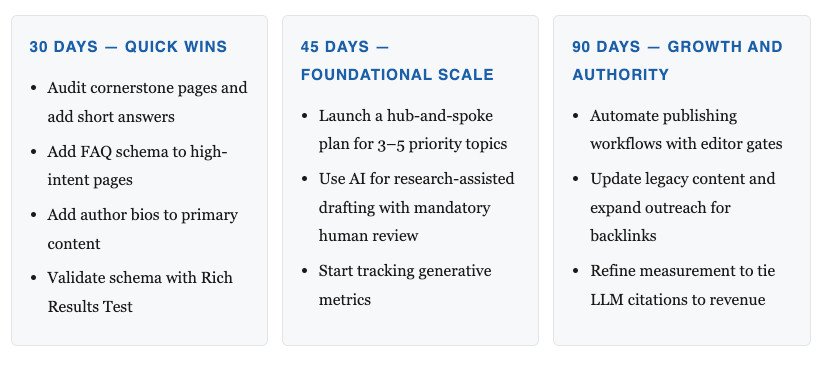
Short, medium, and longer term implications
Short term (0 to 3 months)
You see quick visibility gains from targeted FAQ schema and short answers. Small teams can test the concept with low cost and measure early LLM impressions.
Medium term (3 to 12 months)
Topical authority grows. As more pages are structured for answerability, generative engines find multiple citations and your brand becomes a recurring source. Workflows become routine, and editorial review reduces error rates.
Longer term (12 months and beyond)
Your company may hold persistent citation presence for core buyer questions. This positions you as an expectation setter for buyers and a gatekeeper for key topics. At this stage, maintaining verification processes and updating content regularly is essential to protect that trust.
Action checklist
Put a one-sentence answer at the top of every high-intent page.
Add FAQ schema to product and service pages.
Publish author bios with credentials and Person schema.
Create a citation list for each article with primary sources.
Use HTML text for critical paragraphs so retrieval pipelines see them.
Track LLM citations and generative impressions in a dashboard.
Use AI agents for scale, but require human verification before publish.
Refresh top pages every 30 to 45 days for freshness.
Build internal topic hubs to strengthen entity signals.
Monitor and correct factual errors fast.
Key takeaways
GEO SEO, or Generative Engine Optimization, optimises content to be cited and used by LLM-powered answer experiences.
Short, clear answers, explicit citations, and schema markup increase the chance of being referenced by generative engines.
Small teams can deliver results fast using a 30/45/90 roadmap, AI-assisted drafting, and human verification.
Measure LLM citations, generative impressions, and referral traffic to prove ROI.
Protect trust with transparent sourcing, author credentials, and an editorial review process.
FAQ
Q: What is the primary difference between GEO and traditional SEO?
GEO focuses on making content machine-citable so generative engines can use and cite it directly in answers. Traditional SEO optimises for ranking and clicks in organic results. GEO adds short answers, explicit citations, schema markup, and provenance. It retains classic SEO best practices but adds new signals and metrics — like LLM citation counts — to measure success.
Q: How can my small marketing team get started with GEO right away?
Start with a content audit to find high-intent pages. Add short answer summaries and FAQ schema to those pages. Publish author bios with credentials. Use a 30-day cadence to update top pages and start tracking generative impressions. Use AI-assisted tools for research and drafting, but enforce human review before publishing.
Q: Which schema types matter most for GEO?
Article, FAQPage, QAPage, Person, Organisation, and Dataset schema are most useful. FAQ schema helps engines surface concise Q&A snippets. Person and Organisation schema add author and publisher signals. Dataset schema helps when you publish original data. Always validate structured data so it matches visible content.
Q: How do I measure whether generative engines are actually using my content?
Track generative impressions and LLM citation references using analytics plus specialised tools. Look for increases in answer impressions, mentions in chat-based search, referral traffic from those surfaces, and backlink growth after citation. Tie those signals to conversion metrics to see business impact.
Q: Are there legal or compliance risks with GEO content?
Yes. Automated or AI-assisted content can introduce factual errors. For regulated industries, add legal review and explicit disclaimers. Maintain source lists and a clear audit trail for any factual claim. Human verification is essential to reduce legal exposure.
Q: What quick experiment should I run this week to test GEO?
Pick one high-intent product or service page. Add a 2-sentence short answer at the top, append a 3-question FAQ with schema, and list three primary sources. Monitor generative impressions and citations for 30 to 45 days to measure the effect.
You have the tools and the knowledge now. The question is: will you adapt your SEO strategy to meet your audience's evolving expectations? How will you balance local relevance with clear, concise answers? And what is the first GEO or AEO tactic you will implement this week? The future of search is answer engines - make sure you are ready to be the answer.
About Upfront AI
Upfront AI is a cutting-edge technology company dedicated to transforming how businesses leverage artificial intelligence for content marketing and SEO. By combining advanced AI tools with expert insights, Upfront AI empowers marketers to create smarter, more effective strategies that drive engagement and growth. Their innovative solutions help you stay ahead in a competitive landscape by optimising content for the future of search.