
GEO SEO Explained: What It Is, How It Works, and Why It Matters
GEO SEO, Generative Engine Optimization, is optimizing your content so generative AI systems (ChatGPT, Google AI Overviews, Perplexity, Gemini, Bing Copilot) discover, understand, and cite your brand. It's the convergence of traditional SEO and AI optimization, in 2026, they're no longer separate disciplines. Brands that only optimize for traditional search are becoming invisible.
This article covers what GEO SEO is, its differences from traditional SEO, why it matters now, the signals generative engines use to select citations, and how to start implementing it this week.
Table of Contents
1. What is GEO SEO?
2. How GEO differs from traditional SEO
3. Why GEO SEO matters now
4. How generative engines decide what to cite
5. The key signals that make content GEO-ready
6. GEO SEO vs AEO: what is the difference?
7. How to implement GEO SEO: practical steps
8. How to measure GEO SEO performance
9. FAQ
1. What is GEO SEO?
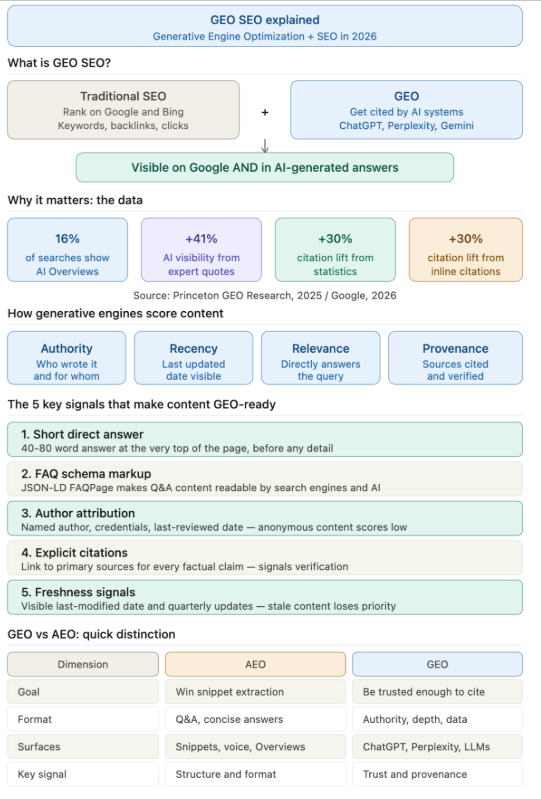
GEO SEO combines two related disciplines into one integrated approach to search visibility in 2026.
Traditional SEO optimises your content so Google and Bing rank it in organic search results. It focuses on keywords, backlinks, technical health, and page experience.
GEO - Generative Engine Optimization - optimises your content so AI-powered systems can retrieve, understand, and cite it when generating answers. Instead of asking "how do I rank for this keyword on Google?" GEO asks "how do I become the trusted source AI engines quote when someone asks this question?"
Together, GEO SEO means creating content that wins both the traditional search result and the AI-generated answer - because in 2026, buyers discover, research, and evaluate options across both surfaces simultaneously.
For a deeper explanation of how GEO works as a standalone discipline, see our guide to what GEO is and how it works.
2. How GEO differs from traditional SEO
Traditional SEO and GEO share the same foundation - good content, technical health, and authority signals. But they diverge in what they optimise for and how success is measured.
Traditional SEO optimises for: keyword rankings, organic clicks, backlinks, page speed, and mobile-friendliness. Success is measured in positions, sessions, and conversions from organic traffic.
GEO SEO optimises for: citation rate in AI-generated answers, inclusion in AI Overviews, LLM reference frequency, and brand mention velocity across AI surfaces. Success is measured in how often your content is quoted, cited, and recommended when buyers ask AI assistants questions relevant to your product.
The tactics overlap significantly. Content that ranks well in traditional SEO - clear, authoritative, well-structured, with strong EEAT signals - is also the content generative engines prefer to cite. But GEO adds specific requirements: short direct answers at the top of pages, FAQ schema, explicit source attribution, author credentials, and machine-readable structure that retrieval systems can parse quickly.
For a full comparison of where the disciplines align and diverge, see our guide to SEO vs AEO vs GEO .
3. Why GEO SEO matters now
Marketing teams are behind the curve. Search behavior has shifted dramatically while most organizations are still optimizing for traditional Google rankings. Today's buyers pose complex, conversational questions to AI tools and get immediate, synthesized answers. Research journeys increasingly begin and end inside ChatGPT, Perplexity, or AI Overviews, with zero clicks to your site.
This creates a visibility gap. Brands that appear in organic search results but not in AI-generated answers are invisible to a growing segment of their buyers. And brands that get cited in AI answers - even without a direct click - gain authority, trust, and top-of-mind presence that influences purchase decisions before a buyer ever visits a website.
AI referral traffic converts at significantly higher rates than organic in B2B contexts, because users who find a brand through an AI citation are already deeper in their research journey.
For a detailed look at how GEO and SEO work together to drive full-funnel growth, see our guide to stacking GEO, AEO and SEO for full-funnel traffic.
4. How generative engines decide what to cite
Generative engines work differently from traditional search crawlers. They do not simply rank pages by keyword match and backlink count. They retrieve candidate passages, score them on multiple dimensions, and synthesise an answer from the highest-scoring sources.
The retrieval stage. The AI system searches its index for passages relevant to the query. Content in clean, accessible HTML that is clearly labelled and structured is easier to retrieve. Content hidden behind JavaScript, in PDFs, or in formats that crawlers cannot parse cleanly gets missed.
For a technical breakdown of how this retrieval and citation process works, see our complete guide to AI SEO and generative engine optimization.
5. The key signals that make content GEO-ready
These are the specific signals that increase your probability of being cited by generative engines.
Short direct answers at the top of every page. Place a 40-80 word direct answer to the primary question at the top of the page, before any supporting detail. Generative engines can extract and quote this answer directly. This is the single highest-impact GEO change most pages can make immediately.
FAQ and QAPage schema. Marking up Q&A content with JSON-LD FAQ schema makes your content programmatically legible to both search engines and AI retrieval systems. Google cross-references the schema with the visible content, so the answers must match exactly.
Author attribution and credentials. Name the author, include their credentials, and link to their profile. Generative engines score content higher when it has clear, verifiable authorship. Anonymous content scores poorly on provenance.
Explicit citations and source links. Link to primary sources - research papers, government data, industry reports - for every factual claim. Generative engines prefer content that is itself well-cited because it signals verification and accuracy.
Freshness signals. Include a visible last-modified date and update content regularly. Generative engines prefer recent sources, particularly for time-sensitive queries. Content that has not been updated in over three months loses citation priority for many query types.
Clean, accessible HTML. Place important content in HTML text rather than JavaScript-rendered elements. Retrieval systems read HTML directly.
For a detailed implementation guide covering all of these signals, see our guide to how to structure content for AI visibility and citations .
6. GEO SEO vs AEO: what is the difference?
GEO and AEO (Answer Engine Optimization) are closely related but distinct.
AEO focuses on winning specific answer placements - featured snippets, voice responses, and Google AI Overviews - by formatting content clearly with question headings and concise answers.
GEO goes deeper: it focuses on becoming the source generative AI systems trust enough to cite and synthesise from in longer answers. GEO requires stronger authority signals - original data, expert commentary, consistent brand mentions, and verifiable sourcing. In practice, both disciplines share most tactics because clarity, authority, and machine-readable structure help both. For a detailed comparison, see our guide to GEO vs AEO .
7. How to implement GEO SEO: practical steps
Start with your highest-traffic pages. Add a 60-word direct answer at the top of each page. Add FAQ schema with three to five questions matching what buyers actually ask. Add an author block with name, credentials, and last-reviewed date.
Audit your schema coverage. Check that your key pages have Article, FAQPage, and Organisation schema correctly implemented and validated in Google's Rich Results Test.
Build a content hub structure. GEO rewards topical depth. Create a pillar article on each major topic, supported by cluster articles covering related subtopics, all interlinked. This hub-and-spoke structure signals to generative engines that your domain has genuine depth on the subject.
Publish original data. Surveys, benchmark reports, and proprietary research are disproportionately cited by AI systems. Even a small dataset with clear methodology is a strong citation signal.
Refresh top pages regularly. Set a quarterly review cadence for your most important pages. Update statistics, add new expert commentary, and update the last-modified date. Stale content loses citation priority.
For a step-by-step guide to making your content AI-readable and citation-ready, see how to make your website AI-readable and citation-ready. For the broader AI-driven content strategy that ties GEO and SEO together, see AI-driven content strategy for SEO growth, AEO and GEO explained .
8. How to measure GEO SEO performance
Track these four metrics alongside your standard SEO reporting:
LLM citation rate. Run target queries through ChatGPT, Perplexity, Gemini, and Claude monthly. Record whether your domain is cited.
AI Overview appearances. Use Google Search Console - the AI Overviews filter shows impression and click data for AI placements.
AI referral traffic. Track in GA4 using source/medium filters for perplexity.ai, chatgpt.com, and gemini.google.com.
Zero-click impressions. Growth in Search Console zero-click impressions often signals AI Overview or featured snippet placements.
For the complete framework, see our guide to GEO, AEO and LLM visibility in 2026 .
9. FAQ
Q: What is GEO SEO in simple terms?
A: GEO SEO means optimising content so it ranks on Google and gets cited by AI systems like ChatGPT and Perplexity simultaneously. Traditional SEO gets you the click. GEO gets you the mention inside an AI-generated answer. In 2026 you need both.
Q: How is GEO SEO different from regular SEO?
A: Regular SEO optimises for keyword rankings and organic clicks. GEO SEO adds optimisation for AI citation - short direct answers at the top of pages, FAQ schema, author attribution, explicit citations, and freshness signals that generative engines use to decide which content to include in their answers. The two share the same technical and content foundation but GEO adds specific structural and provenance requirements.
Q: Which AI platforms does GEO SEO target?
A: Google AI Overviews, ChatGPT, Perplexity, Google Gemini, and Microsoft Bing Copilot. Each retrieves and cites sources differently, but the same signals - clear answers, strong authorship, structured data, and fresh content - improve citation probability across all of them.
Q: How long does it take to see GEO SEO results?
A: Schema and short-answer additions can show results in Google AI Overviews within days. LLM citations in ChatGPT and Perplexity typically appear within weeks to months for well-structured content on an authoritative domain. Consistent citation presence builds over 3-6 months.
Q: Is GEO SEO worth it for small marketing teams?
A: Yes. The highest-impact GEO changes - a short answer at the top of a page, FAQ schema, named author - take under an hour per page. For teams that need scale, AI-driven platforms apply these signals across hundreds of pages automatically.
Key Takeaways
-
GEO SEO means optimising for both traditional search rankings and AI citation simultaneously - two disciplines that share a foundation but require distinct signals.
-
Generative engines score content on authority, recency, relevance, and provenance. Strong performance on all four is what drives citation.
-
Highest-impact GEO changes: short direct answers at the top of pages, FAQ schema, named author, and explicit source links.
-
GEO and AEO are related but distinct. AEO is about being extracted as a snippet. GEO is about being trusted enough to be quoted by a generative AI system.
-
Measure GEO performance with LLM citation tracking, AI Overview impressions in Search Console, AI referral traffic in GA4, and brand mention velocity.